Toddler Gymnastics: From Cute, Clumsy Tots to Confident Kids
15 Ways Toddler Gymnastics Builds Strong Bodies, Minds, and Confidence
Why do preschool and toddler gymnastics programs oftentimes fill up faster than any other program gymnastics clubs offer? Answers would vary, for sure. But parents are realizing more than ever the importance of exercise in developing strong, healthy bodies and minds.
Did you know toddlers today are getting way less exercise compared to what they did 20 years ago? The reasons?
- increased screen time
- sedentary lifestyles
- minimal outdoor playtime
Many families have found a solution that offers far more than just physical exercise:
Toddler gymnastics!
What’s so great about gymnastics? Let’s break it down and take a look at the many reasons gymnastics for toddlers is an ideal activity that gives your tot an incredible head start in life. You’ll discover it’s far more that just physical!
First we’ll cover the negative side of things when a toddler isn’t exposed to enough physical activity. Then we’ll move to the amazing benefits toddler gymnastics can have on the body, brain, and emotional well-being of your little one.
A Far Cry from 20 Years Ago!
We all love our technology. But it has come with a high price tag. Sadly, our kids have suffered physically, mentally, emotionally, and relationally. And much of that is directly related to the lack of exercise.
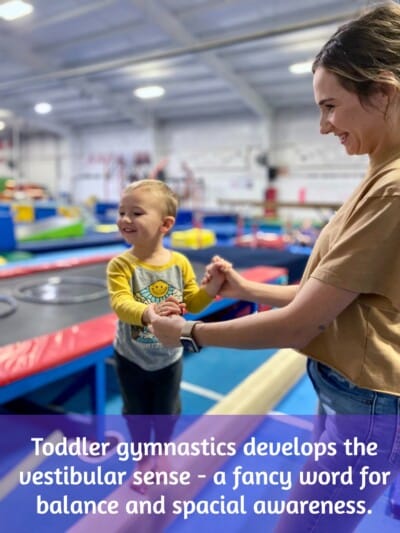
Exercise has far-reaching effects on a toddler’s vestibular [1] and proprioceptive development [2]. The vestibular sense is all about balance and spacial awareness. It supports balance and muscle tone. Without it, we couldn’t even maintain our posture when we’re sitting still! It’s also the key to spatial awareness which keeps us from falling or bumping into other things or people.
The proprioceptive sense makes us aware of how our body parts move. Without it, you wouldn’t be able to direct your fork to your mouth. Or you might hug your kids or dog too tightly. Nor would you be able to calm yourself down when needed.
What happens when a toddler isn’t exposed to enough physical activity? The list is long! But here are some that pertain to balance and spatial awareness.
Consequences of Under-Developed Vestibular and Proprioceptive Senses
- Poor balance and coordination: An under developed vestibular system can lead to difficulties with simple tasks such as walking, running, and playing.
- Reduced body awareness: Proprioception is like a body map in your brain. It helps you know where your body parts are without looking at them. This can lead to clumsiness, difficulty with motor skills, and problems with self discipline and controlling emotions.
- Slower development of large motor skills: Basic movements like crawling, walking, and jumping require good balance and spacial awareness. Too much sitting can set the toddler behind developmentally in these essential skills.
- Poor posture: Toddlers have always been superb examples of excellent posture. Without strong muscles and joints, which are developed through exercise, they can lose the ability to hold proper body positions.
- Weak muscles and joints: Our body learns to sense its position and movements by carrying heavy things or working against resistance. Without this type of activity, muscle and joint strength suffers.
- Difficulty fitting in: If a toddler does not develop good balance and coordination, they might find it harder to engage in play and social activities. Unfortunately, the clumsy child who lacks confidence can become the object of the playground bully.
Technology is also a big reason toddlers have forsaken the lifestyles of the earlier generations.
Negative Effects of Technology and a Sedentary Lifestyle [3]:
- Increased risk of obesity: Lack of exercise has dramatically increased the percentage of kids who are now overweight and even obese. This has caused numerous health problems – type 2 diabetes being one of the biggest – which can last a lifetime.
- Emotional challenges: Exercise is essential for mental health. A lack of physical activity can lead to problems like anxiety, depression, and low self-esteem.
- Poor social skills: Less face-to-face interaction means less opportunity to develop social skills and difficulty in understanding emotions.
- Poor sleep quality: Overexposure to screens, especially before bedtime, can disrupt sleep patterns and cause sleep issues.
- Increased risk of behavior problems: Too much screen time has been linked to increased aggression and hyperactivity in children.
- Delayed language development: Lack of real-life interactions and conversations can slow down language development and vocabulary growth.
- Reduced attention span: Excessive screen time can lead to shorter attention spans and difficulty focusing on tasks.
- Decreased creativity and imagination: Too much screen time stifles creativity and imagination. Toddlers are naturally curious. More than one hour of daily screen time can rob them of the opportunity to develop this part of their brain.
- Disrupting parent-child interaction: This is absolutely critical to healthy emotional and cognitive development.
These negative effects are certainly concerning. But if your tot is getting plenty of exercise, the chances of him or her experiencing such things is greatly reduced.
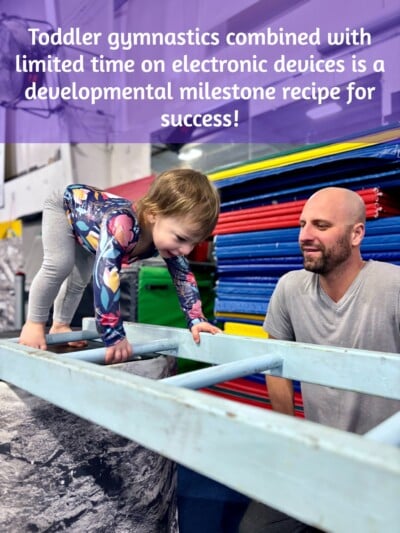
And now for the good part! Toddler gymnastics combined with limited screen time is a developmental milestone recipe for success!
15 Ways Toddler Gymnastics Builds Strong Bodies, Minds, and Confidence
1. Improved spatial awareness: Toddler gymnastics classes use preschool sized equipment and introduces them to a variety of movements. This helps toddlers learn about their body in relation to their surroundings.
2. Better balance and coordination: All sports require some level of balance and coordination as well as regular daily physical activities. Gymnastics for toddlers includes balance beam walking, tumbling, and hanging from bars. All of these improve balance and coordination, strengthening the vestibular sense.
3. Stronger muscles and flexibility: Gymnastics affects all the muscles in the body and makes them more flexible. This helps with posture, reduces the chance of getting hurt, and makes it easier to do other physical activities.
4. Better fine motor skills: Gymnastics movements require precision and control which develop fine motor skills. This can help them with things like holding objects, using utensils, and writing.
5. Increased self-esteem and confidence: When toddlers learn new skills in gymnastics and see their progress, they feel good about themselves and their abilities. This increases confidence, not only in gymnastics, but also in other areas of life.
6. Improved focus and concentration: Toddler gymnastics requires them to pay attention to the instructors and how they perform on equipment. This helps them develop better focus and concentration skills. Plenty of studies have been done to show the correlation between exercise and school performance. [4]
7. Social development: When toddlers participate in gymnastics classes, they get to interact with other kids. They learn to take turns and improve their communication skills. They also make new friends!
8. Inverted movements: Beginning cartwheels, handstands, and hanging upside down are all part of gymnastics for toddlers and develop their vestibular system.
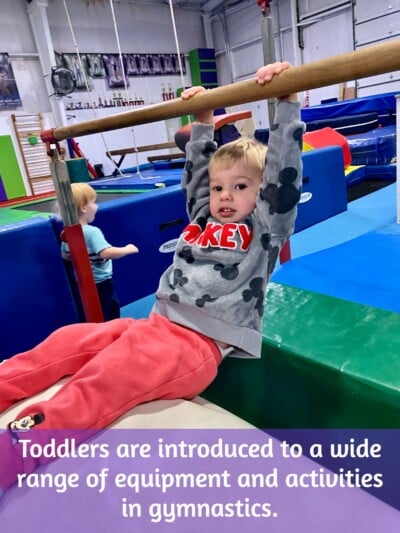
9. Varied activities: Toddlers get a big range of exposure to different activities in gymnastics, like swinging on ropes and bars, and jumping on trampolines. These all help develop a good sense of where their bodies are in space.
10. Less injury prone: Toddlers who exercise regularly develop a strong vestibular system. With good balance and spatial awareness they are less likely to fall when running, jumping, and playing.
11. Improved coordination: Jumping, crawling, climbing, pushing, pulling, stretching – these are movements that build a strong proprioceptive system. This results in better coordination and body awareness. It also helps toddlers grasp objects, useful for playing future sports.
12. Development of big movements: Gross motor skills, like crawling, walking, and jumping, depend on a strong foundation in vestibular and proprioceptive development. Plenty of exercise will develop these skills more quickly.
13. Healthy weight: Learning to love exercise (along with a nutritious diet) helps to keep toddlers at a healthy weight. These two factors prevent obesity and other health problems.
14. Emotional well-being: Physical activity is important for mental health. Even toddlers can begin to feel like failures. The experience of learning new skills elevates their ‘happy hormones’. They feel good about themselves which reduces the risk of anxiety and depression.
15. Parent-tot bonding: Toddler gymnastics classes give Mom or Dad the opportunity to spend valuable time with their tot. The parent-child interaction that takes place establishes a strong foundation for building a close, lasting relationship. This is critical to the health and well-being of the child.
Toddler Gymnastics and Problem Solving
Can you imagine trying to get through life without problem-solving skills? Yikes! Yet our society has become so dependent on the internet for answers – and now AI – that many parents are wondering how this is affecting the brain development of their kids.
Problem-solving skills are essential for kids to develop. Kids need to learn how to think in order to find answers to problems they face. Whether in school, sports, or with friends, problems happen – and their phone won’t always be there to give them an answer!
Toddler gymnastics classes (also called Mommy and Me classes) are the ideal place to start your tot on their problem-solving journey. What problems do little ones encounter in class? They will have to figure out things like:
“How do I…
- navigate over, under, and through these blocks and tunnels?”
- stay balanced on a trampoline?”
- climb up and over this ladder?”
- get out of this ball pit (or foam pit)?”
- hold onto a rope and swing?”
- get my hands and feet in the right place on this rock wall?”
Using Manipulatives in Toddler Classes
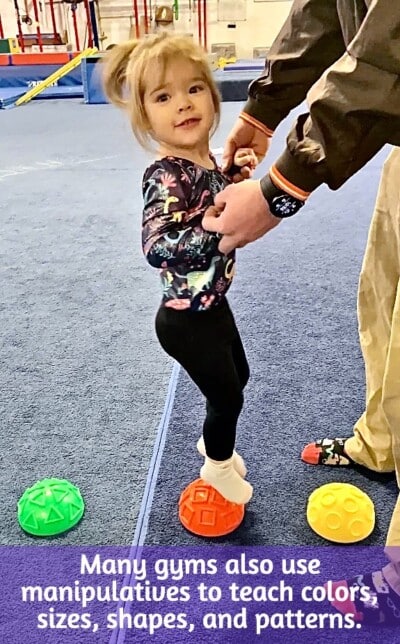
Many gyms also use manipulatives to teach colors, sizes, shapes, and patterns. Toddlers learn the meaning of up, down, right, left, sideways, forward, and backward. Manipulatives like stuffed animals, blocks, little soccer balls, etc., are used along with directional cues to create challenges on special toddler sized equipment. An example might be:
“Walk sideways down the beam with your arms out like airplane wings. Try to step over the alligators onto the yellow placemats without knocking the alligators off.”
This is a lot for the toddler mind to grasp! Mom or the instructor is there to guide them through the process. But they also give the tot time to think for themselves and grow their own problem-solving skills.
Parents can encourage their toddler to solve problems by asking questions rather than immediately giving them answers or doing it for them. “Can you show me what airplane arms look like?” “You’re walking forward. Can you walk sideways now?”
It’s never too early to begin teaching problem-solving skills! Toddler gymnastics is ideal because they’re introduced to so many new pieces of equipment and manipulatives that aren’t found in most homes.
Many mental and physical challenges can be created that will stimulate brain and muscle growth at the same time. You or the instructor is right there to help if needed, removing fear and allowing their natural curiosity flourish. So much confidence is instilled during this process!
“Our daughter has learned so much from her Tiny Tots class! Her balance, strength, and confidence has greatly increased since starting at EmethGym. We are so thankful to have the ability to expose our girl to gymnastics at such a young age. Highly recommend bringing your little one here to burn off some energy and learn new tricks!!” ~ Mercades H.
Conclusion
The toddler season of life is so short. Yet, during those few years and into the preschool years, more brain development occurs than at any other time. The brain forms an incredible one million neural connections per second! These connections are essential for language, motor control, and cognitive functions – including developing the vestibular and proprioceptive senses. By the age of three, the brain has laid the foundation for future learning and development.
The number of neural connections made depends on the number of experiences the growing child is exposed to. That’s why it’s so crucial to introduce toddlers to a variety of new, stimulating environments that require both their brain and body to engage.
We love our cute and clumsy toddlers! Trying as they may be at times, when looking back, we mostly remember the good things and sometimes even wish we could go back to those days.
But the last thing we want is for them to stay in that clumsy phase. We want to give them every opportunity to grow strong in body and mind. We want them to gain the confidence that comes with learning new skills. And we want them to develop the capabilities needed to be fully equipped to creatively solve the problems they will face.
It all starts with letting toddlers be the naturally curious little people they are. Give them as many chances as possible to grow their bodies and minds. Toddler gymnastics is one of the best ways to accomplish this goal! Search for “toddler gymnastics near me” and get started today!
About EmethGym
Kids gymnastics classes are fun and full of new experiences! But they should be more than that. It’s hard to find fun activities that will also challenge kids to grow both inside and out. A good gymnastics program understands that and creates an environment for that to happen. The best programs take time to develop written curriculums to achieve that goal.
At EmethGym, we use caring coaches, character training, and focus on individual progress. Our coaches receive regular safety and gymnastics training. They also focus on applying our unique character training program during each class. As a result, we’ve been producing confident, fit, young leaders since 2000. To learn more about the Emeth Way, click here.